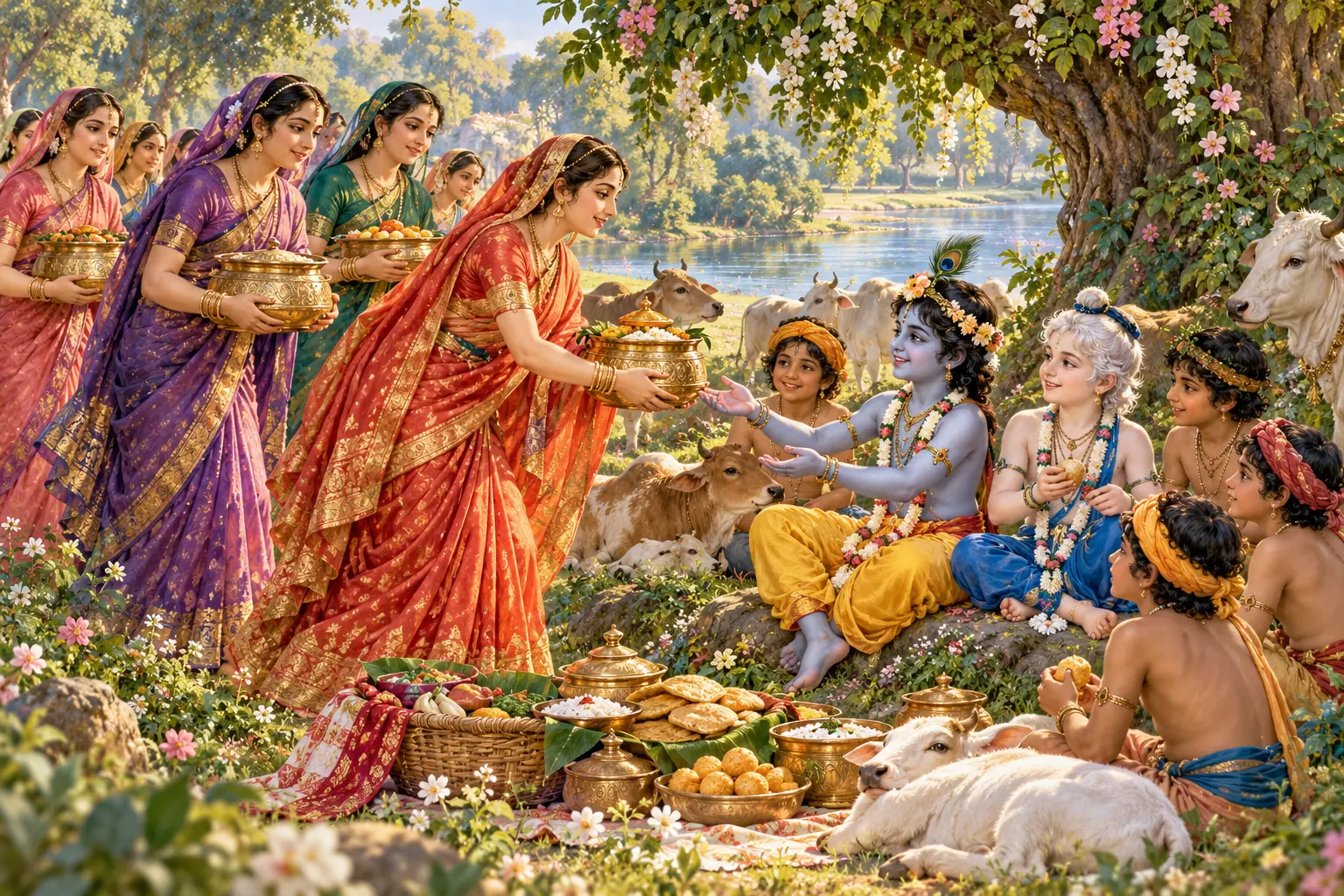
Midday approached as Krishna and Balarama tended the cows in the forest. The cowherd boys were hungry; they had missed breakfast that morning. Their games continued, but their lunch bags could not feed everyone. They told Krishna what they needed without ceremony. He sent them to brahmanas conducting a sacrifice nearby. Food had been prepared there, and the boys hoped for hospitality. They asked simply for a meal for Krishna, Balarama, and their friends. On one side lay the forest path; on the other, the place of ritual. The boys approached those learned in Vedic practice with respect. They did not know what answer they would receive.
The brahmanas were busy with the order and rules of their rite. The boys approached politely and explained who had sent them. Krishna and Balarama were nearby with the cows, they said. There was no need for a long debate about the food. Hungry children stood before them, asking to share a meal. Yet the brahmanas did not even give a clear reply. Their silence weighed more than a simple refusal. The rite continued while the guests went unnoticed. The boys knew the words of respect and now learned about indifference. They returned to Krishna empty-handed.
Krishna listened and smiled. He did not scold them for bringing no food. He told them that one who asks for help will not succeed everywhere. One refusal need not end hope. He then sent them to the wives of those same brahmanas. These women had long heard of Him and held Him in their thoughts. This time the boys were to speak the names of Krishna and Balarama. The same request was going to another door. The difference was not eloquence, but a willingness to listen. The friends set off again.
The women received the boys in their homes. The boys bowed and brought the message from the forest. Krishna, Balarama, and the cowherds were hungry and waiting nearby. As soon as the women heard those names, they began preparing gifts. They filled vessels with a variety of cooked foods. Each carried something that could be shared. They waited for neither a special invitation nor lengthy confirmation. To them the food was more than part of a ceremony. It could become direct service to the One they had heard about. Their decision was quick, though the love behind it had grown for a long time.
Their relatives tried to hold them back as they left. The women nevertheless carried the food toward the forest. The path led them toward the bank of the Yamuna. Greenery and flowering vines changed the face of the landscape. They were not seeking praise for their generosity. They wanted to see Krishna in person. The vessels in their hands showed practical care. Each step brought them nearer the hungry boys awaiting a meal. What looked to others like an interruption of the rite was their answer to a call. So they reached the place where the cows were grazing.
Under the trees they saw Krishna with Balarama and His friends. Krishna wore yellow cloth, a garland of forest flowers, and a peacock feather. He held a lotus and rested a hand on a friend's shoulder. The sight before them was both simple and unforgettable. The One they had heard about stood in the ordinary life of Vraja. The women came forward with their vessels and respect. The hungry boys were no longer forgotten. The meeting was no reward for a perfectly performed ritual. It came through their readiness to serve. Krishna welcomed them kindly.
He recognized their affection and sincere purpose. The women wished to remain near Him. They knew questions and possible reproach awaited them at home. Krishna told them their families would receive them. He asked them to return and continue their household duties. His words did not undo the meeting. They showed that remembrance of Him could continue at home. The women voiced their fear that they had no other shelter. Krishna assured them their devotion would not be in vain. The meeting stayed in their hearts even as the path led back.
The women returned to their homes. The brahmanas received them, and the sacrifice continued with them. But their earlier silence could no longer be ignored. The men realized they had failed to answer a request sent by Krishna. They regretted their pride and their failure to recognize their visitors. They praised their wives for their clear devotion. Knowledge of ritual had not helped them notice the need at their door. The women had noticed without argument or delay. In the forest Krishna and His friends shared the food they had brought. A day that began with hunger ended in a meal and a lesson.
The source chapter also tells of one woman unable to go with the others. She remained at home, but her thoughts stayed with Krishna. This difficult part shows how deep their remembrance had become. Not every path toward a meeting looks the same. One person carries a full vessel through the forest; another cannot leave home. The story does not erase the difference between those circumstances. Still, it gives them the same center: longing for Krishna. The brahmanas, despite their regret, feared approaching Him in person. The contrast is therefore more than one group of people against another. It is between knowledge that stops and love that moves.
Think of the hungry boys returning the first time without food. Then picture those same boys bringing the message to the women. A small word from the forest opens a chain of generous actions. Vessels are filled, a path is crossed, and the food is shared. Devotion has hands and feet in this story. It listens, prepares, carries, and returns with new understanding. Krishna is at the center of the rite and of an ordinary lunch with friends. The scene by the Yamuna is therefore part of everyday life. It asks whether we hear the person knocking at our door. And whether we can turn our respect into care.