The morning in Vraja began with the sound of Krishna's horn. The cowherd boys came out with lunch bags and their calves. Each carried a stick, flute, or horn, but the best part was going together. The forest opened before them while the village courtyards fell behind. The calves looked for fresh grass and the boys for their next game. Krishna walked among them as a friend among friends. No one expected this day to differ from the others. That ordinary happiness was part of the wonder of life in Vraja. Their path led past trees, water, and open places to play. Everyone looked forward to the meal they would share later.
One boy tucked a feather into his hair; another found a flower or leaf. As they walked, they passed a friend's lunch bag from hand to hand in jest. Its owner ran after it while the others laughed. Whenever Krishna went ahead to see something, all tried to reach Him first. Flutes and horns sounded alongside boys imitating birds. Some followed the moving shadows of birds across the ground. Others watched peacocks and tried to copy their dance. By the water, frogs and their own reflections entertained them. The forest was a place of friendship to them, not a place of fear. Their closeness to Krishna was the heart of that morning.
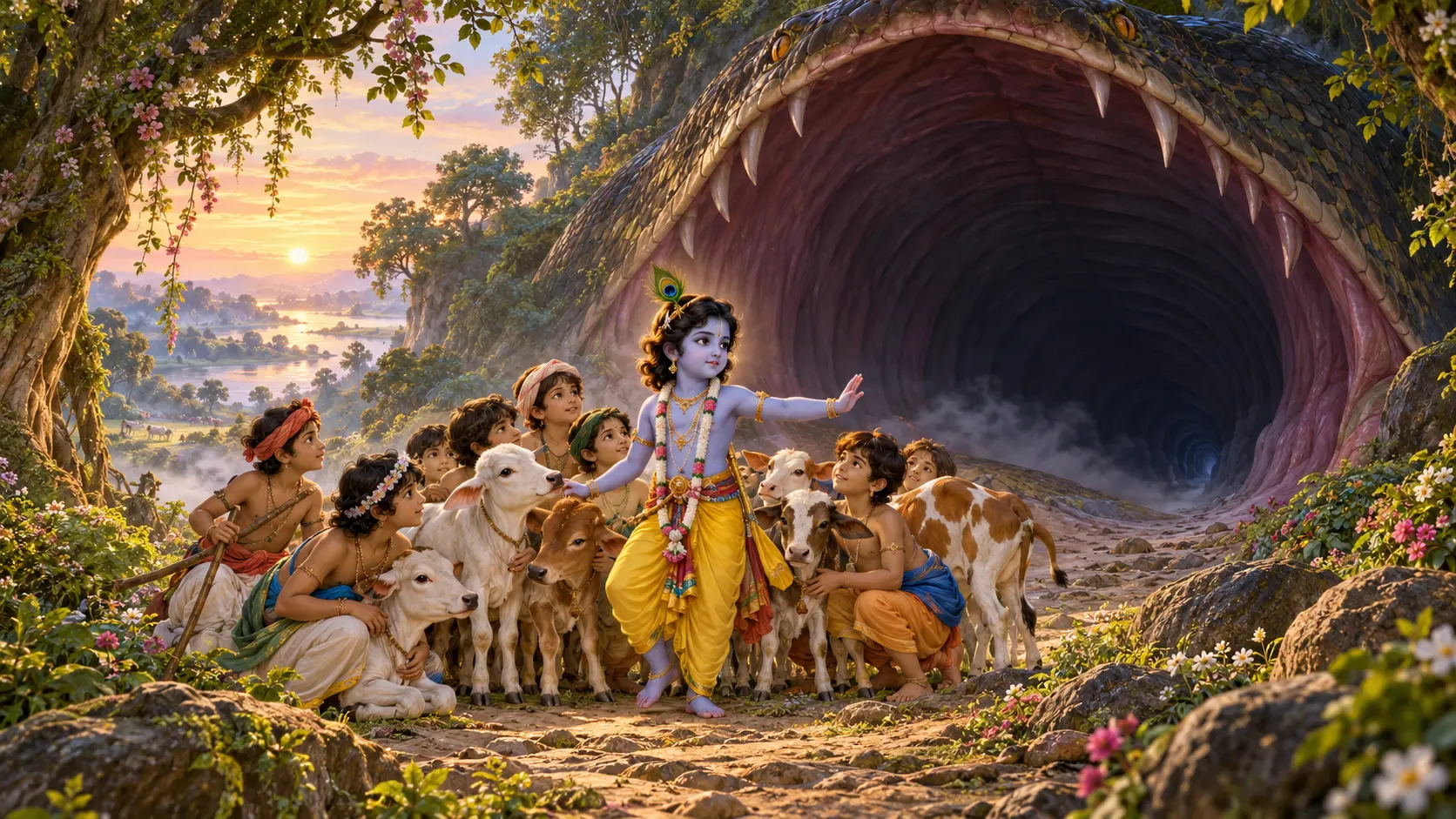
Yet Aghasura waited on the path with a hostile purpose. He was the brother of Putana and Bakasura and sought revenge. He could not bear to see Krishna among happy friends. He planned to swallow the boys and calves together. Through extraordinary power he took the form of an immense serpent. He lay so that his open mouth crossed the forest path. From a distance it resembled the entrance to a mountain cave. The darkness inside looked like a long passage through rock. Even the air coming from it hinted at danger. The happy excursion had met something the children did not expect.
The boys stopped and studied the strange sight. They saw a high upper edge and a lower edge touching the ground. What looked like rocks were the serpent's teeth. The broad passage was really its tongue. Some wondered whether it was an animal or a very unusual cave. They talked over one another with the curiosity of children. Though they recognized a possible danger, they remembered Krishna was there. They recalled that He had protected them before. They looked toward Him, smiled, and clapped their hands. Then they went into the opening with the calves.
Krishna understood that this was no ordinary cave. He saw Aghasura's plan as His friends were already entering. The boys followed the path inside, with the calves ahead. Outside was the light that had accompanied them a moment earlier. The serpent waited for Krishna to enter before closing his trap. Krishna's concern was to bring everyone out, not merely stop an enemy. This is the turning point: His friends are inside while He is still outside. Their joyful play has become a matter of life and death. Krishna did not leave them alone in the darkness. He followed them in.
When Krishna entered, Aghasura believed his plan had succeeded. The heavenly witnesses watched with alarm. From outside the opening still resembled a cave, but it was no cave. Inside were the children who had set out to play that morning. Their lunches, small flutes, and calves were trapped with them. Krishna expanded Himself within the serpent's throat. Aghasura could no longer breathe, and his strength failed. The trap he had laid for others brought his attack to an end. The danger was overcome without the boys having to fight. Now everyone had to return to the light.
The boys and calves had lost consciousness inside. Krishna revived them with His glance and led them out. One by one, they reappeared on the forest path. For them the morning light now meant something more. They were together, and Krishna was with them. The heavenly beings scattered flowers in joy. What seemed a certain loss had ended in rescue. The source also tells of a light leaving Aghasura and joining Krishna. Even the attacker's end thus has a spiritual dimension in the original account. For the boys, the closest wonder was simpler: their friends were alive.
The serpent's open mouth remained there and gradually dried out. Later the boys could look at it without fear. A place of danger became part of their memory of play. In Vraja, however, the incident was not told at once. The chapter says the boys spoke of it at home a year later. That curious delay leads into the next account of Brahma and the cowherd boys. This day is therefore woven into the days that follow. Childhood play, danger, and later remembrance meet within it. The boys who left with lunch bags returned with much to wonder about. Krishna again walked among them as their closest friend.
Aghasura saw the boys as targets of his revenge. Krishna saw them as friends to be protected. That difference carries the weight of the story. The boys did not call Him with ceremony or a complicated prayer. They were with Him in games, laughter, and everyday closeness. Their trust was so natural that they walked into the dangerous opening. The account does not pretend that the danger was good. It shows Krishna entering exactly where His friends had gone. He did not stand at a safe distance and merely watch. He brought them back to the world they knew.
When you picture that morning, you may first hear the horn. Then come the laughter of the boys and the sound of their flutes. The path continues into the darkness of the false cave. After it, the forest light opens once more. Between those moments stands Krishna's choice to follow His friends. The source describes His power; this retelling also follows their closeness. The calves, lunch bags, and flowers matter alongside the great event. They remind us that love in Vraja lives within ordinary hours. When those hours are threatened, protection becomes personal. At the end the friends are together again beneath the sky of Vraja.