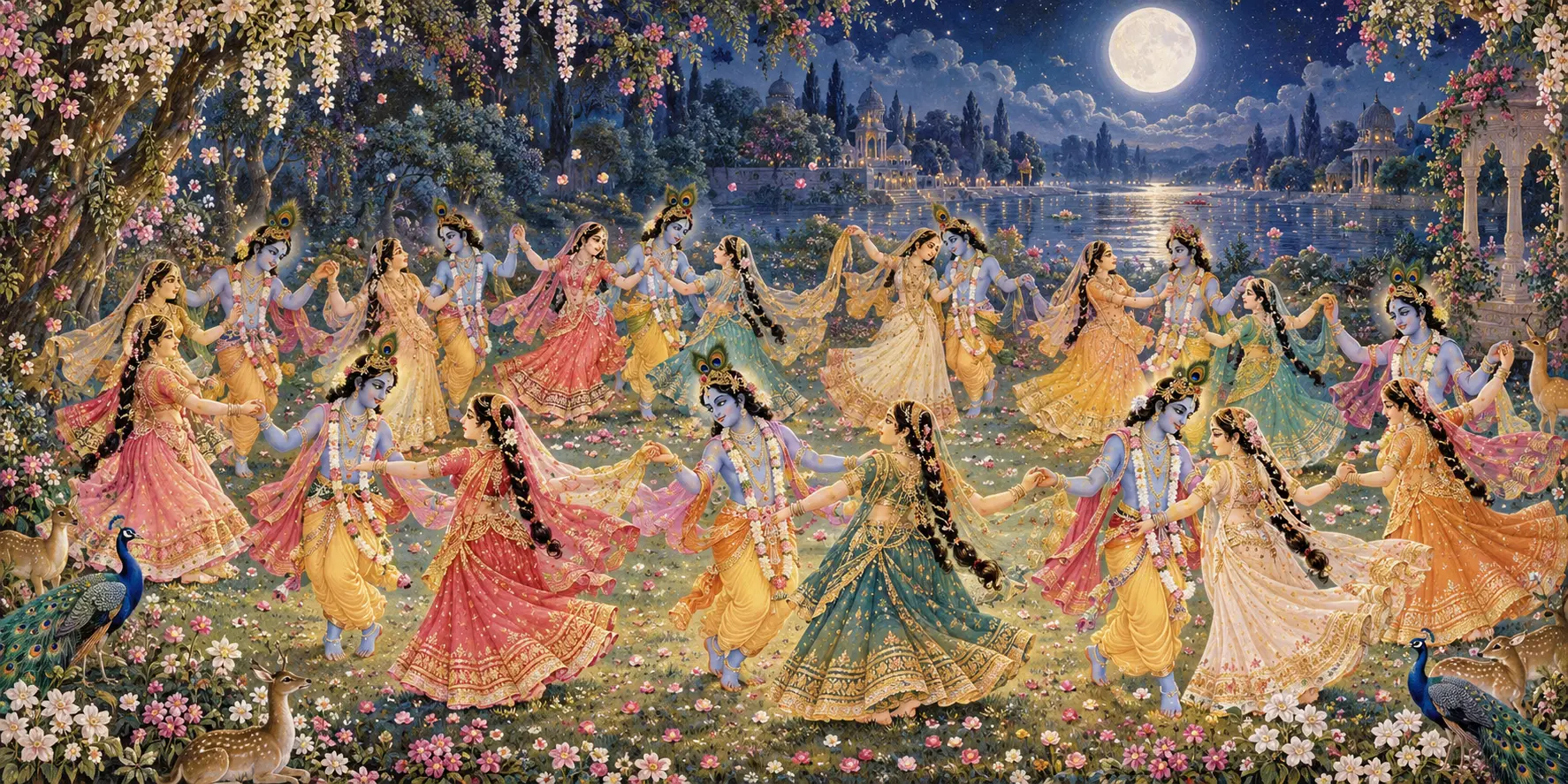
Krishna's answer had eased the gopis' sorrow. On the Yamuna bank, conversation gave way to song and movement. The autumn moon stood high above the forest. Flowers on the trees scented the night. The gopis gathered in a circle around Krishna. Their renewed togetherness took a new form. The source chapter calls this scene the rasa dance. It did not begin as a performance for visitors. It continued the call, search, song, and answer. Without those earlier chapters the circle would be only an image.
Krishna appeared beside every gopi. In the source this is His extraordinary divine power. Each felt that He was personally with her. No one had to divide His attention as though it were a limited thing. The circle moved with many presences of the same Krishna. To ordinary sight the scene seems impossible. That is why the account does not describe an ordinary dance. What cannot happen in daily life is part of its spiritual meaning. The gopis were not competing for a place in the circle. Krishna answered their devotion with His presence.
Song, footsteps, and the sound of ornaments could be heard. Jewels and ankle bells followed the rhythm of movement. Flowers from garlands swayed and fell to the earth. Some gopis sang, and Krishna answered them. When He sang, they encouraged Him with delight. Their song was no longer only a plea from the riverbank. Now it belonged to the meeting. Forest, river, and moon surrounded the circle. The account dwells on its sound as much as its appearance. The dance was also a way of listening to one another.
When movement tired them, some gopis leaned on Krishna. He noticed their weariness. Their joy did not mean they needed no rest. In the source that attentiveness is part of the meeting. Flowers scattered among their steps. The singing continued in new voices. Heavenly beings, the account says, watched in wonder. Flowers fell from above. Yet the center remained on the bank with Krishna and the gopis. Joy was lived there, not merely observed.
After dancing, they went toward the Yamuna. The cool river gave them rest. They laughed and refreshed themselves in the water. Flower garlands loosened on its surface. The river that had heard their song now joined their play. The night was not yet finished. They came out and walked along the bank. The breeze carried the scent of flowers over the water. Krishna spoke and recited verse to them. After the great circle came a quiet walk.
The account does not end with the sight of the dance. King Parikshit, who heard the narration, raised a question. How should something so unusual be understood? Could a reader mistake it for an ordinary human example? Sukadeva Gosvami answered by drawing a distinction. Krishna is not limited like an ordinary person. His act in this chapter is no pattern to imitate. Parikshit's question guards the story against a careless reading. It is part of the chapter, not an appendix after the dance. So this retelling makes room for it too.
The source emphasizes the spiritual nature of rasa-lila. It does not make the scene a license to exploit another's trust. Respect for the gopis means seeing their devotion. Respect for Krishna means seeing His unique position. The two perspectives belong together. A person who claimed His place would miss the meaning. The book states this warning plainly. The hearer is left with remembrance, song, and service. That path does not ask us to copy a divine event. It asks us to understand where love is directed.
The circle joins what happened across the five chapters. The flute had called the gopis. Disappearance led them among trees and footprints. Song gathered them beside the Yamuna. Conversation let them speak their question. Now the dance shows the joy of renewed closeness. No part stands alone. Grief is not erased as though it never happened. It becomes part of a wider account of love and response. The ending reads differently when we know the path toward it.
Moonlight fell over trees and sand. The Yamuna carried that light in its water. Voices that once called now sang in His presence. Krishna was among the gopis, each feeling Him close. No single illustration can contain the whole scene. The illustration is therefore only an artistic reminder. The source chapter holds more detail and more questions. Open it to follow Parikshit and Sukadeva's conversation. There the account explains its spiritual frame. These lines follow the path; they do not replace the source.
At the end one feels the circle closing again. The opening call has received an answer. Those who sought are together now. Memory of the search makes the reunion deeper. Song and conversation keep the dance from empty beauty. Krishna's care and the gopis' faithfulness carry its heart. The five stories can be read separately. Together they reveal a path from sound to presence. Return to the first and you may hear the flute differently. Its call now knows the whole way to the Yamuna.