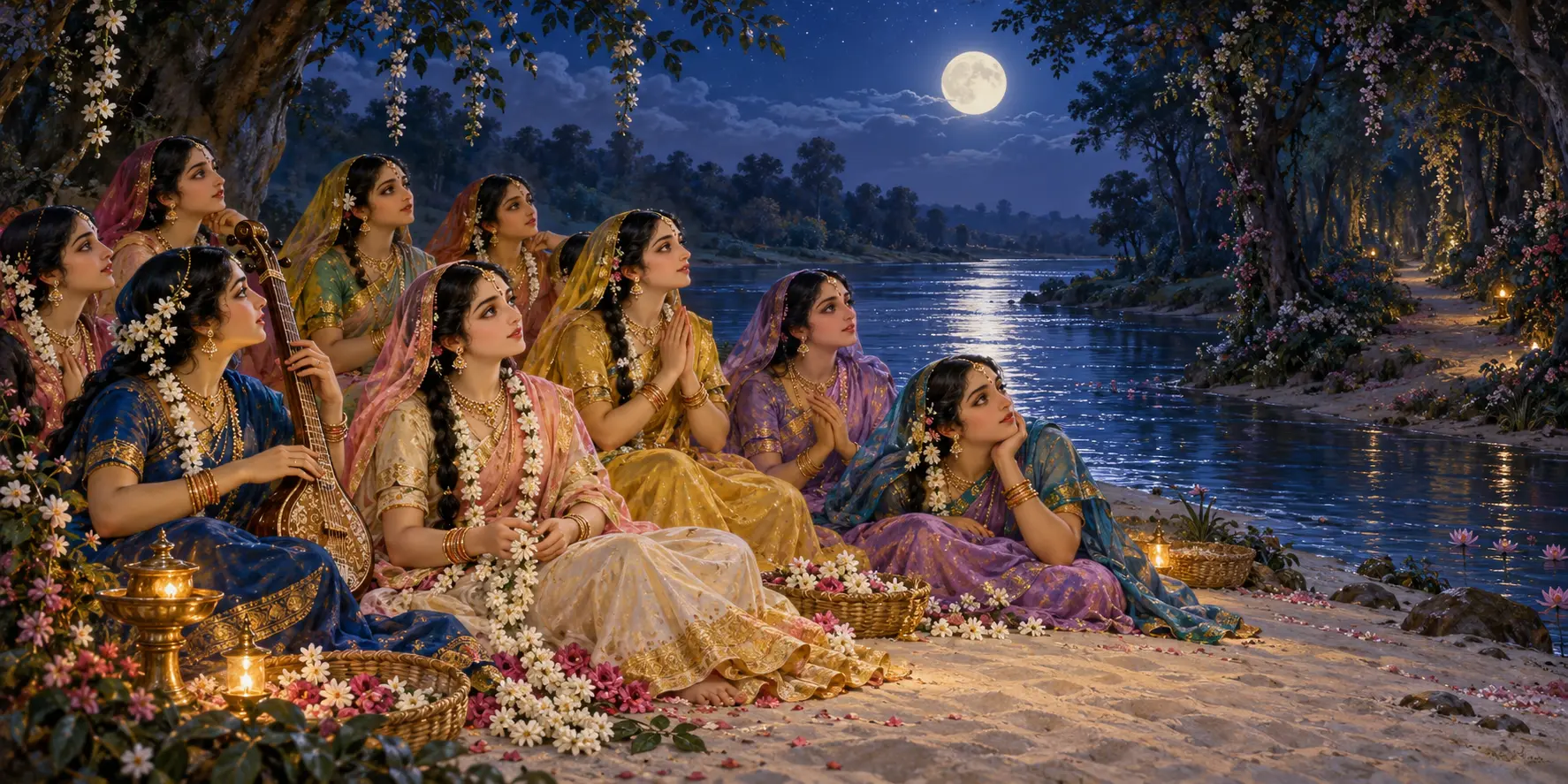
After the search the gopis gathered on the sandy bank of the Yamuna. The moon still stood over the river. The forest behind them held the tracks they had followed. Before them the water quietly returned the night's light. Krishna was not among them. Hope that He might hear their voices joined them. So they began to sing of Him. They were not a chorus performing for an audience. Their song was a conversation with an absent Friend. Chapter thirty-one follows that conversation.
First they remembered the land of Vraja. Krishna's presence had made it especially blessed to them. Yet the beauty of the place did not erase their grief. Flowers and river were dear because He had walked among them. Without His gaze, even the loveliest night felt incomplete. They did not ask for a new landscape. They sought the One who gave meaning to the familiar one. Joy for Vrindavan met longing in their voices. Neither feeling canceled the other. The song could carry both.
Then they remembered how often Krishna had protected them. The dangerous water of the Yamuna entered their memory. So did the serpent Kaliya. They recalled Indra's storm and shelter beneath Govardhan. They remembered the forest fire and other fears in Vraja. Each event said He had been near when danger came. That made His present absence harder to bear. They called to the protector who knew their voices. They did not list those scenes to demand repayment. They spoke them as memories of trust.
Their thoughts turned toward His feet. They pictured Him leading the cows through the forest. His soft feet, they worried, met stones and dry grass. Even when He was away by day, they cared for Him. They remembered His return along the path at evening. Dust from the hooves then covered His face. Beneath His curling hair they saw His gentle gaze. Such a small everyday sight could fill their day. Now that memory deepened their separation. Their concern for Him remained when He was unseen.
They also remembered His words. Conversations with Krishna returned to them in difficult hours. Stories of His deeds passed from voice to voice. The source chapter values the hearing of those accounts. Someone who shares them gives joy to another. The gopis were already doing so beside the river. Their song did not seal sorrow inside a private circle. It opened sorrow into a call others could hear. Even the quietest memory found a place in the shared voice. Words became an extension of their search.
Krishna's smile was close in memory. They recalled the way He looked at them. They recalled the flute that had begun the night. The flute was silent now, but they could sing. Between the two calls lay a silence they could not skip. Instead of hiding it, they gave it a voice. The song holds a plea and also gratitude. It asks why Krishna had hidden. It says that their lives are bound to Him. These feelings stand beside one another.
They knew Krishna as more than the son of Nanda and Yashoda. At the same time He was near as a resident of their Vrindavan. That double vision gives the song its force. Divine protection does not take Him away from forest paths. His greatness does not make their memories insignificant. They called to Him with closeness, not a cold formula. They asked Him to appear again. They expected kindness from Him because they had known it. This was no theoretical thought beside the river. It was personal remembrance spoken together.
Some verses in the source are full of powerful images of love. This retelling does not replace those verses. It follows their main movements: praise, concern, and call. The song itself is best read in the source. Here one can notice how every image carries a relationship. The river recalls rescue. The path recalls His feet. The evening dust recalls His return. The flute recalls His call. Everything in Vraja becomes a way to remember Krishna.
The night did not pass quickly for those who waited. The moon's reflection shifted across the water. The gopis did not know when they would see Him again. Still they went on singing. Their common voice kept them in one place. No one could fill the absence alone. Together they could speak what they were missing. There is no new chase through the forest here. The movement lies in words and remembrance. That is why the song is a story of its own.
The next chapter will bring Krishna back among them for a conversation. Before His answer stands this song. It shows that waiting was not empty time. The gopis remembered rescue, flute, and footsteps. They made the riverbank a place of living hope. You may read the song as a path between memories. Each memory ends with the wish to see Him again. Its strength is more than the beauty of its words. It is the faithfulness of those who keep calling. Above the Yamuna the song continues as the night listens.