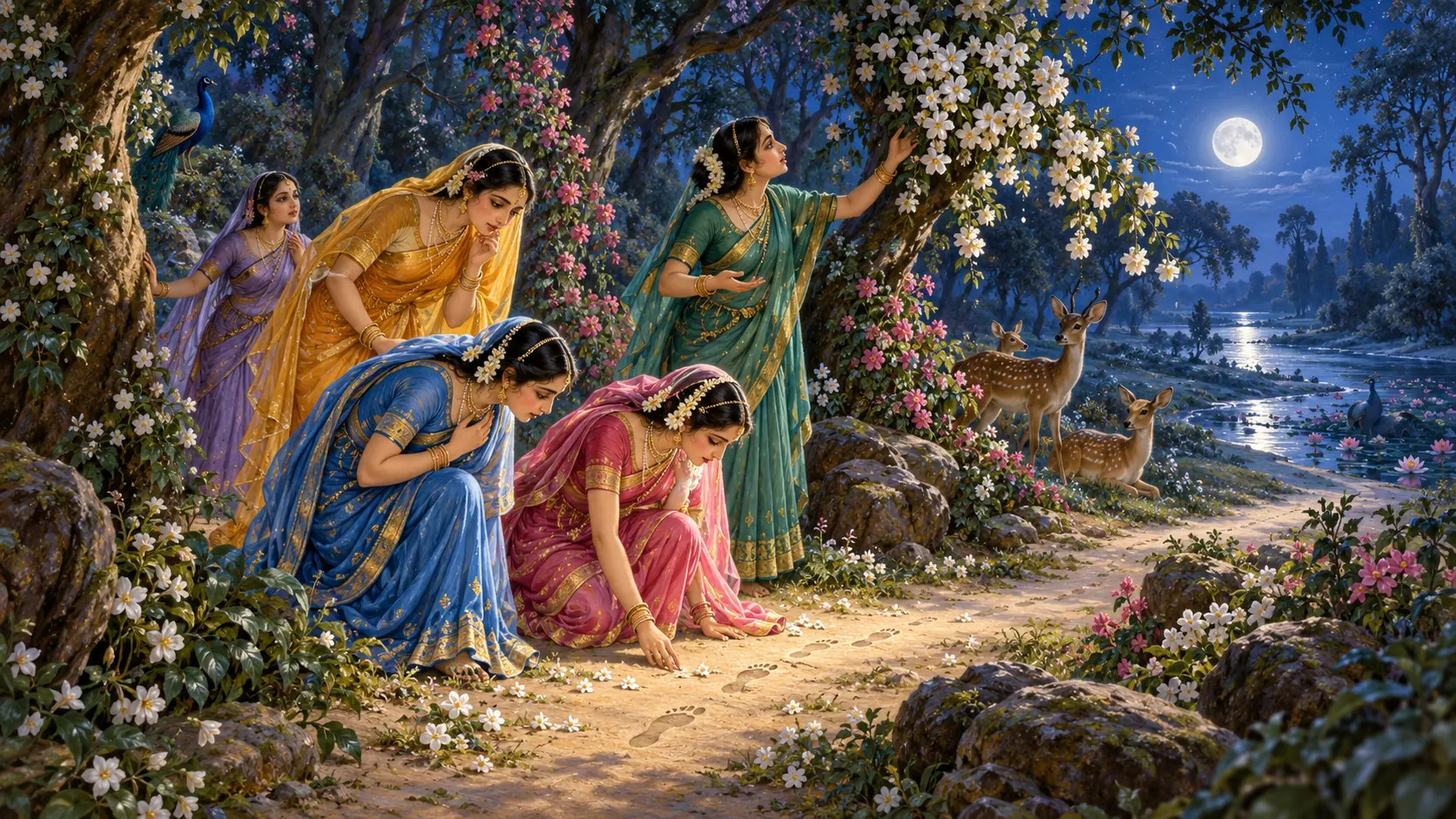
Krishna vanished while the moon still lit the same forest. The gopis remained where they had been with Him a moment earlier. Every leaf looked familiar, but nothing felt quite the same. His absence sent them searching at once. They did not agree on a single best path. They called to one another and spoke His name. In place of conversation came careful listening. Perhaps a step, a sound, or a trace would show the way. The Vrindavan forest became their map. Chapter twenty-nine ended; chapter thirty began with a search.
They addressed the tall trees like old witnesses. They asked the banyan whether it had seen Nanda's son. The ashoka and flowering trees heard the same appeal. The gopis knew trees do not answer in human words. Yet their longing made the whole landscape a companion. A bent branch made them wonder whether Krishna had passed. The scent of a flower recalled His garland. They even questioned the vines embracing the trunks. In every motion of nature they sought a sign. No answer was enough to stop their search.
Tulasi felt especially close to them in that questioning. Her leaves belong to the worship of Krishna. The gopis also looked toward the earth beneath their feet. It bore His tracks and so seemed blessed to them. A few deer watched quietly from beside the path. They asked the deer whether they had seen Him. The breeze carried fragrance, but no certain direction. They went on among the trees along the Yamuna. Their search was both a journey and an act of remembrance. Each question showed how much they wanted to see Him again.
Tired from walking, they began recalling His pastimes. One gopi reenacted a scene from His childhood with Putana. Another played out the story of the overturned cart. Some imitated the cowherd friends and their voices. They remembered how Krishna called the cows by name. One lifted an arm, recalling the shelter of Govardhan. Another portrayed His victory over Kaliya. These were not ordinary games to pass the night. Every movement tried to keep Him present in memory. In His absence, they brought His deeds to life.
Then they found impressions on the ground. In the dust they recognized marks associated with Krishna's feet. They all bent down for a closer look. At last their search had a visible direction. They followed the line of prints among the trees. Where the sand was soft, the marks were clearer. Where the ground was hard, they had to search again. Their delight at the discovery sharpened their attention. But another set of footprints appeared beside His. A gopi had been walking with Him.
The discovery brought mixed feelings. They wondered who had received such special closeness. They spoke with admiration of her love and devotion. At the same time they felt the ache of being left alone. The tracks led toward a quieter part of the forest. At one place her footprints disappeared. They concluded that Krishna had carried her. At another, His steps suggested He had reached up for a flower. They pictured the tenderness of their walk. Every slight change in the sand became part of the account.
The source chapter names the chosen gopi as Radharani. Her special nearness to Krishna unsettled the others. Yet she too could not keep the meeting as a private reward. Krishna disappeared from her sight as well. Now Radharani stood alone in the forest. What had prompted comparison turned into compassion. When they found her, they listened. Rather than remain divided by envy, they gathered around her. They understood her sorrow. All of them were seeking the same Krishna.
Together they went deeper among the trees. The moonlight weakened beneath dense branches. They could no longer follow the tracks with confidence. They stopped before the darkness of the forest. It would not be wise to lose one another. Their shared search now took a different form. Where the path ended, singing began. Their thoughts returned to His voice and face. Grief had not taken away their ability to be together. Instead it joined their voices.
They returned to the bank of the Yamuna. The moon illuminated the sand there. They sat in hope that Krishna would appear again. Rather than fall silent, they spoke and sang of Him. The forest search had given them many images to remember. The trees, deer, and footprints remained in their thoughts. Radharani was with them. No one had found Krishna alone. Now their companionship became a place for hope. The next chapter continues that very song.
This story moves from pride toward care. At first the gopis felt another had been chosen. At the end they received her sorrow as their own. The footprints taught them to look closely. The disappearance taught them to listen closely. Neither forest nor sand could hold Krishna in place. Yet their search had not been in vain. It had brought them back to one another. On the Yamuna bank they turned separation into song. With that voice chapter thirty hands the story to the next.